

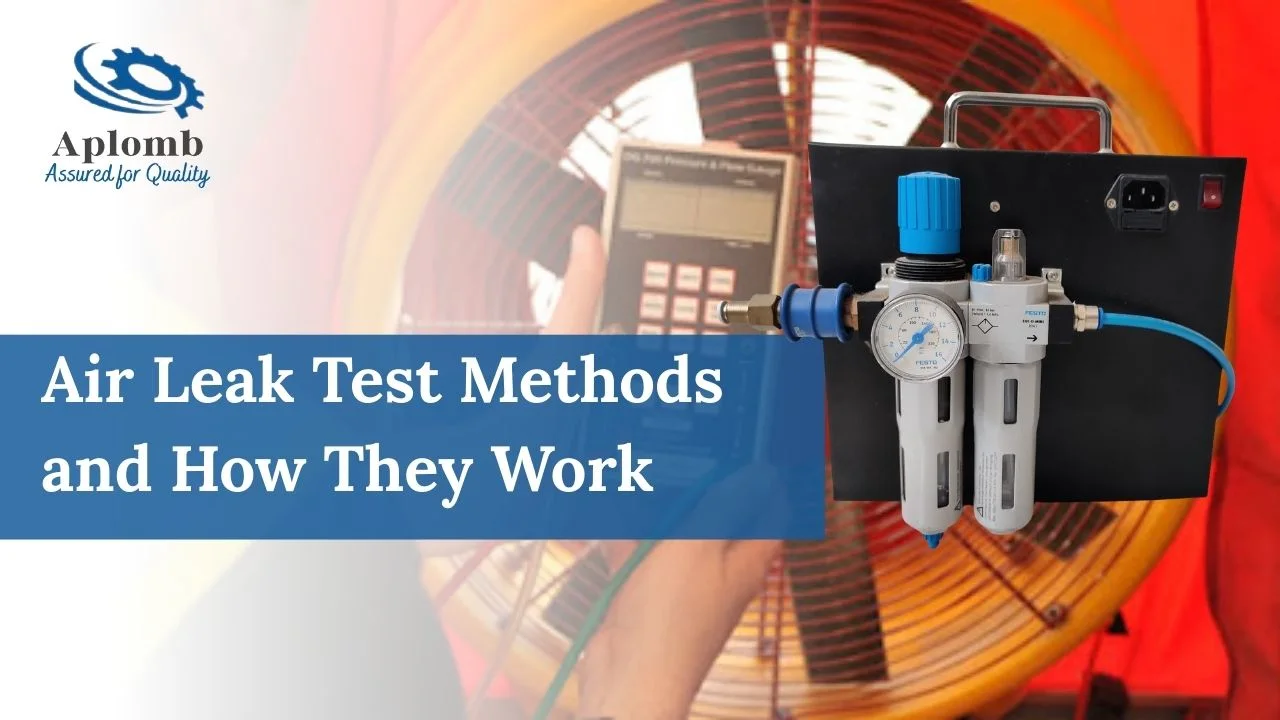
Aplomb Machines has always believed that quality, reliability, and precision are the foundations of any successful industry. In manufacturing units, assembly lines, automotive plants, packaging industries, and HVAC systems, even the smallest leak can lead to major problems. That is why air leak test plays a vital role in ensuring product safety, efficiency, and performance. Many businesses today rely on modern air leak test methods to detect flaws early, reduce wastage, and ensure their products meet global quality standards.
What Is Air Leakage Testing?
Air leakage testing refers to the process of checking whether a component, system, or sealed product allows unwanted air to escape or enter. This type of testing is crucial in applications where airtightness determines functionality—such as fuel tanks, brake systems, valves, pipes, medical devices, radiators, and many more.
Why Is Air Leakage Testing Important?
Leaks can be costly. Whether it is a vehicle brake line, a plastic container, or an industrial pipe, poor sealing can compromise safety and performance. Some reasons why air leakage testing is essential include:
- Ensures product safety
- Prevents downtime and failures
- Helps meet industry certifications
- Saves material and manufacturing costs
- Ensures customer satisfaction
A trusted air leak test process helps industries maintain consistent product quality and avoid unnecessary rework.
Common Air Leak Test Methods and How They Work
There are several methods used in industries today, each suited for different applications depending on accuracy requirements, product type, and testing speed. Below are the most widely used methods and their working principles.
1. Pressure Decay Leak Test
One of the most popular and cost-effective methods is the pressure decay test. Here’s how it works:
- The test part is filled with air at a set pressure.
- The system isolates the part and monitors the pressure drop over time.
- If the pressure decreases, it indicates air leakage.
This method is simple, reliable, and works well for detecting medium to small leaks. Aplomb Machines offer pressure decay testing systems with high-precision sensors that ensure accuracy.
2. Vacuum Decay Leak Test
In this method, the test part is placed under a vacuum instead of pressure.
- The component is evacuated to a predetermined vacuum level.
- The system monitors the vacuum decay.
- A rise in pressure indicates a leak.
Vacuum decay testing is highly sensitive and ideal for sealed components such as electronic devices, sensors, and medical equipment.
3. Mass Flow Leak Test
This method measures the actual flow of air escaping from a part.
- The test system forces air through the component.
- Sensors measure the amount of air flowing continuously.
- Excess flow indicates a leak.
Mass flow methods provide quick results and are suitable for parts where leak rates need to be measured precisely.
4. Helium Leak Test
This advanced method is used for extremely small leaks.
- Helium gas is used because its molecules are tiny and can pass through microscopic openings.
- Detectors sense the presence of helium escaping from the test part.
Though costly, this test is the gold standard for industries such as aerospace, refrigeration, and high-precision manufacturing.
5. Bubble Immersion Test
Also known as the “water dunk test,” this is a simple method:
- The part is pressurized with air.
- It is submerged in water.
- If bubbles appear, it indicates air leakage.
This method is quick but not suitable for precise measurements. However, it is commonly used for simple, low-cost parts.
Also Read : What Is Broaching and How Does It Work?
Steps in a Typical Leak Test Procedure
A standard leak test procedure generally includes:
- Filling – Air is supplied to reach the required pressure.
- Stabilization – The system waits for temperature and pressure to settle.
- Measurement – Sensors monitor pressure, vacuum, or flow.
- Evaluation – Data is analyzed to determine pass or fail.
- Documentation – Test results are recorded for quality assurance.
Following a proper leak test procedure ensures accurate and consistent results across all batches.
Applications of Air Leakage Testing
Different industries require air leakage testing, including:
- Automotive fuel tanks and brake lines
- Medical devices and tubes
- HVAC systems and air ducts
- Plastic and metal containers
- Home appliances
- Industrial valves, pumps, and pipes
Every industry trusts Aplomb Machines to offer robust testing solutions tailored to their requirements.
Air leakage testing is an essential part of quality control in modern manufacturing. With various air leak test methods such as pressure decay, mass flow, helium testing, and vacuum decay, industries can detect even the smallest defects. Aplomb Machines is committed to delivering advanced equipment, expert support, and accurate inspection systems that offer reliable results. With the right leak test procedure, your products stay safe, efficient, and durable just the way your customers expect.