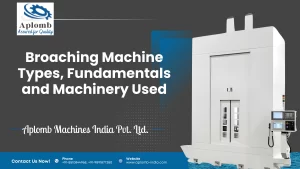

A broaching machine is an important piece of industrial equipment used to remove material from a workpiece and create accurate shapes, slots, grooves, keyways, and internal profiles. It is widely used in automotive, aerospace, engineering, manufacturing, and metalworking industries where precision and consistency are essential. A broaching machine uses a special cutting tool called a broach, which has a series of teeth that gradually increase in size. As the tool moves across or through the workpiece, each tooth removes a small amount of material until the desired shape is achieved.
Aplomb Machines India Private Limited offers industrial machining solutions designed to support manufacturing requirements and improve production efficiency. Understanding the machine’s types, operations, and advantages helps businesses select the right equipment for their applications.
What Is a Broaching Machine?
A broaching machine is a machine tool that uses a toothed cutting tool to remove material in a single continuous stroke or a series of controlled strokes. These machines are commonly used to manufacture internal keyways, splines, square holes, gear profiles, and other precision components. Depending on the workpiece and application, manufacturers can choose between horizontal, vertical, hydraulic, and other specialized broaching systems. The appropriate machine depends on factors such as material type, component dimensions, production volume, and required surface finish.
Types of Broaching Machines
Different types of broaching machines are designed to handle specific machining requirements. Selecting the right configuration helps manufacturers achieve accurate results and maintain consistent production.
1. Horizontal Broaching Machine
A horizontal broaching machine operates with the broach moving horizontally through or across the workpiece. It is suitable for long components and applications that require sufficient space for the cutting tool.
2. Vertical Broaching Machine
A vertical broaching machine operates with the cutting tool moving in an upward or downward direction. Its compact layout makes it useful for factories where floor space is limited.
3. Hydraulic Broaching Machine
Hydraulic broaching machines use hydraulic pressure to move the broach through the workpiece. These machines are useful for operations that require stable performance and consistent machining quality.
4. Surface Broaching Machine
Surface broaching machines remove material from the external surface of a workpiece.This type is suitable for components that require repeatable external features.
5. Continuous Broaching Machine
Continuous broaching machines are designed for high-volume production. Workpieces move through a continuous machining system while the broaching tools perform the required cutting operation.
Types of Broaches
The cutting tool plays a major role in the performance of a broaching machine. Different types of broaches are available to suit specific machining requirements.
- Internal Broach: Used to machine internal shapes, including keyways, splines, and square or polygonal holes.
- Surface Broach: Designed to remove material from external surfaces and create flat or contoured profiles.
- Keyway Broach: Used to cut keyways in shafts, hubs, and other mechanical components.
- Spline Broach: Produces accurately shaped splines that help transmit torque between connected components.
- Pot Broach: Commonly used to machine external profiles on components passed through a specially designed cutting tool.
- Progressive Broach: Uses a sequence of cutting teeth to gradually remove material and achieve the required profile.
Choosing the correct broach depends on the workpiece material, desired dimensions, machining allowance, and required finish.
Broaching Machine Operation
The broaching machine operation involves positioning the workpiece securely and moving the broach through or across it to achieve the required shape. Although the exact process depends on the machine type, the main steps are generally similar.
1. Workpiece Preparation
The operator checks the dimensions and material of the workpiece before machining. Proper preparation helps ensure accurate cutting and reduces the risk of tool damage.
2. Tool Selection and Setup
A suitable broach is selected according to the required profile. The tool and fixture are installed correctly, and the machine settings are adjusted based on the workpiece and production requirements.
3. Workpiece Clamping
The component is secured in the fixture to prevent movement during cutting. Correct alignment is important for maintaining dimensional accuracy and avoiding uneven tool loading.
4. Cutting Process
The machine moves the broach through or over the workpiece. The progressively larger teeth remove material in stages until the desired shape and dimensions are achieved.
5. Inspection and Finishing
After machining, the finished component is inspected for dimensional accuracy, surface quality, and profile consistency. The workpiece may then proceed to cleaning or additional manufacturing operations.
Broaching Machine Diagram
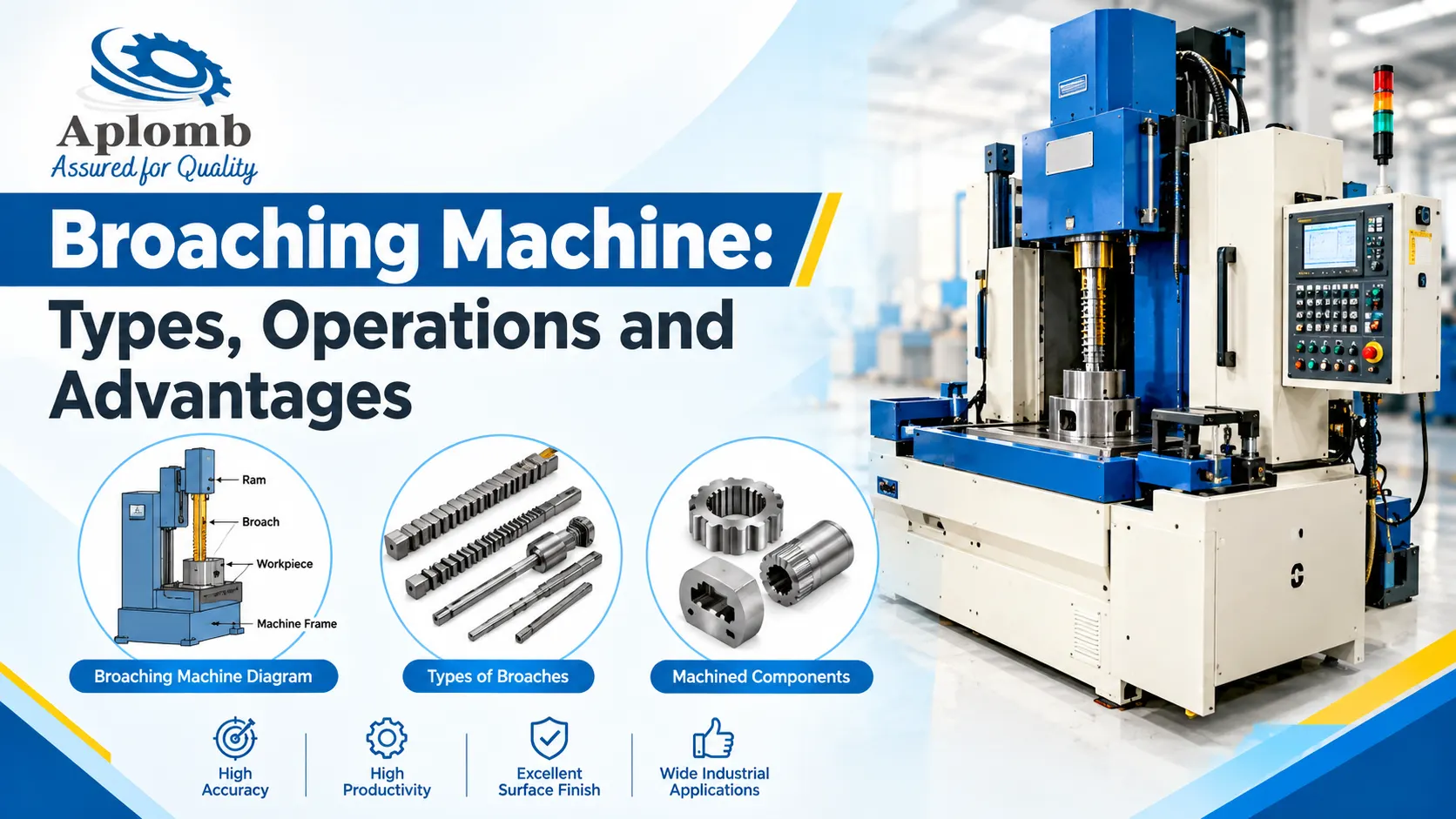
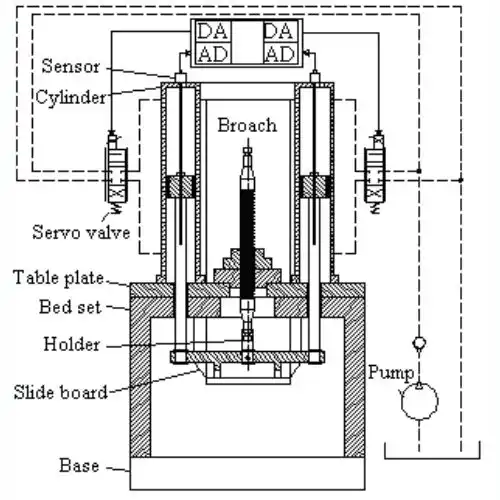
A broaching machine diagram provides a visual explanation of the machine’s major components and their functions. Depending on the design, the diagram may show the machine frame, broach, ram or drive mechanism, work-holding fixture, hydraulic system, and workpiece.
In a vertical machine, the diagram typically illustrates the vertical arrangement of the tool and the workpiece. Reviewing a vertical broaching machine diagram can help operators understand tool alignment, movement direction, and the relationship between the cutting tool and the component. It is also useful for technical training, maintenance planning, and understanding the machine’s working principle.
Advantages of Broaching Machines
Broaching machines provide several benefits for industrial manufacturing, particularly when components require precise and repeatable profiles.
- High Production Speed: Broaching can complete complex machining operations in a short cycle, making it suitable for medium- and high-volume production.
- Excellent Dimensional Accuracy: The specially designed cutting tool helps produce consistent dimensions and profiles across multiple workpieces.
- Improved Surface Finish: Broaching can deliver a smooth surface finish, reducing the need for additional machining in suitable applications.
- Consistent Quality: Once the machine and tool are correctly set up, repeated operations can maintain uniformity across production batches.
- Reduced Secondary Operations: Many profiles can be completed in a single pass, potentially reducing additional machining steps and overall production time.
- Wide Industrial Applications: Broaching machines are used in automotive parts, gears, shafts, industrial machinery, aerospace components, and precision engineering products.
Broaching machines are valuable tools for manufacturers seeking accurate profiles, consistent quality, and efficient production. Understanding the types of broaching, the available broach designs, and the complete machining process helps businesses make informed equipment decisions. Aplomb Machines India Private Limited offers industrial machine solutions to support different manufacturing needs. By selecting the right machine configuration, cutting tool, and operating method, businesses can improve productivity, maintain component quality, and achieve reliable machining results.