
Many manufacturers invest in high-tonnage machines believing bigger automatically means better. In reality, hydraulic press performance depends on several factors including stroke length, daylight opening, bed size, cycle speed, hydraulic system efficiency, and application requirements.
A hydraulic press should be selected based on the actual production process rather than simply choosing the highest tonnage available. At Aplomb Machines India Private Limited, we offer advanced hydraulic presses solutions designed to deliver maximum efficiency, precision, and reliability across various industrial applications.
What Is Hydraulic Press?
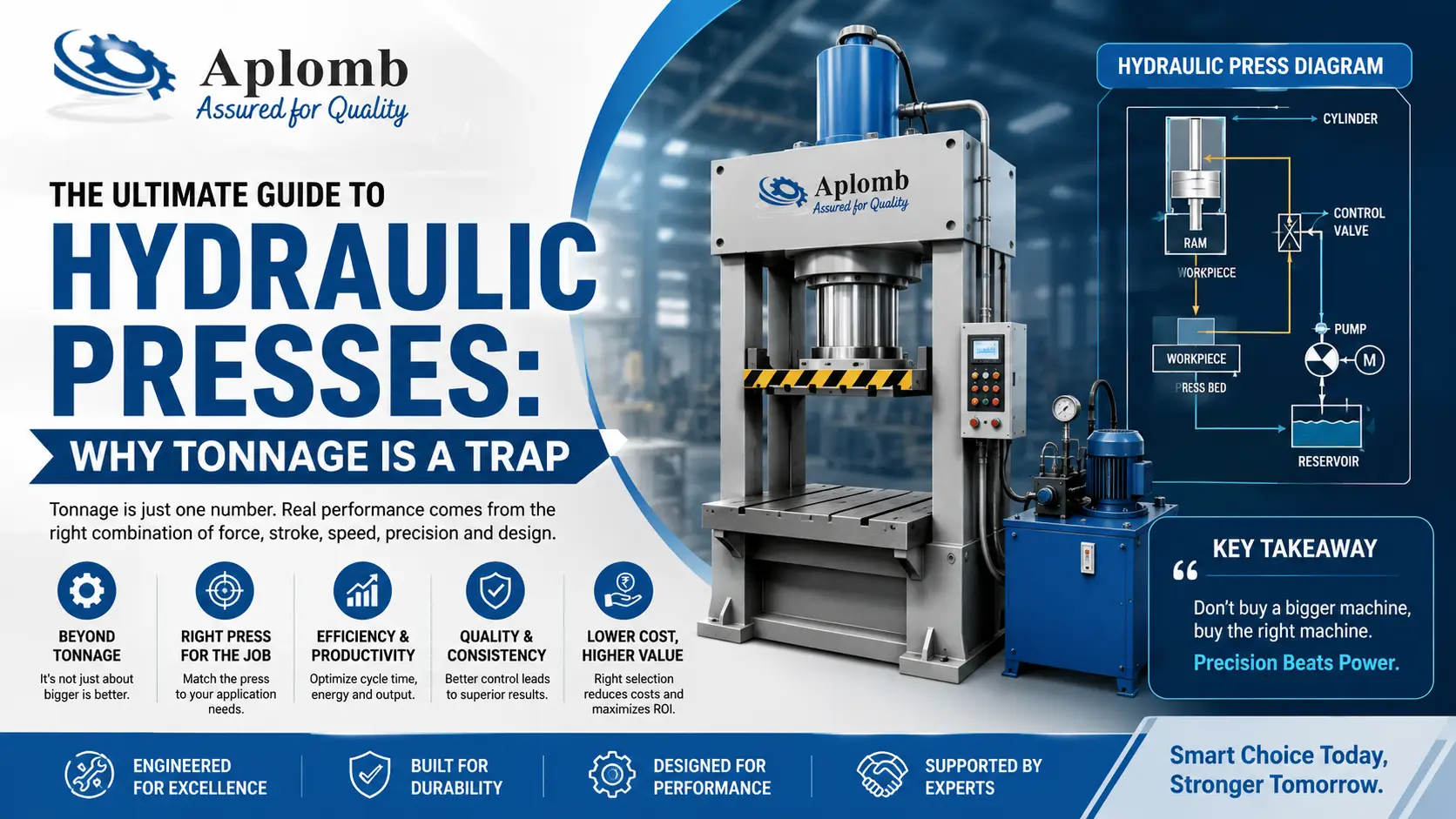
A hydraulic press is a machine that uses hydraulic fluid pressure to generate a large compressive force. Based on Pascal’s Law, pressure applied to a confined fluid is transmitted equally throughout the system, allowing a relatively small input force to create a much larger output force. The working principle can be understood through a basic hydraulic press diagram, which consists of a hydraulic cylinder, piston, hydraulic pump, reservoir, control valves, and press frame. These components generate the force needed for industrial operations.
Hydraulic Press Diagram
Before selecting a press, it is important to understand the machine structure. A standard hydraulic press machine diagram typically includes:
- Hydraulic Cylinder: The cylinder converts hydraulic pressure into mechanical force.
- Piston and Ram: The piston moves inside the cylinder and transfers force to the workpiece through the ram.
- Hydraulic Pump: The pump creates fluid pressure required for operation.
- Control Valves: These regulate pressure, flow rate, and movement direction.
- Reservoir Tank: Stores hydraulic fluid for continuous circulation.
A properly engineered diagram of hydraulic press systems helps operators understand force transmission, pressure generation, and machine functionality.
Also Read : How does a Servo Press Work?
Role of Hydraulic Press Machine Diagram in System Design
A detailed hydraulic press machine diagram allows engineers to analyze:
- Force generation
- Fluid flow paths
- Valve arrangements
- Pump sizing
- Safety mechanisms
- Energy efficiency
Proper system design ensures that the machine delivers required performance without unnecessary overcapacity. A well-designed diagram of hydraulic press systems also simplifies maintenance and troubleshooting.
┌─────────────────────────────────────────────────────────────┐
│ HYDRAULIC PRESS DIAGRAM │
└─────────────────────────────────────────────────────────────┘
          Hydraulic Oil Reservoir
                   │
                   ▼
            ┌───────────┐
            │ Hydraulic │
            │   Pump    │
            └─────┬─────┘
                  │
                  ▼
          ┌──────────────┐
          │ Control Valve│
          └──────┬───────┘
                 │
                 ▼
        ┌──────────────────┐
        │ Hydraulic Cylinder│
        └────────┬─────────┘
                 │
                 ▼
              ┌─────┐
              │ Ram │
              └──┬──┘
                 ▼
        ┌─────────────────┐
        │   Workpiece     │
        └─────────────────┘
                 ▲
                 │
         ┌─────────────┐
         │ Press Bed   │
         └─────────────┘
Importance of Hydraulic Efficiency
Modern hydraulic presses must balance force output with energy efficiency.
Key efficiency factors include:
- Variable Displacement Pumps: Reduce energy consumption by supplying only the required flow.
- Servo Hydraulic Systems: Improve accuracy while lowering power usage.
- Optimized Hydraulic Circuits: Minimize pressure losses throughout the system.
- Advanced Control Systems: Allow precise force and motion control.
These technologies help manufacturers achieve superior performance without relying solely on high tonnage ratings.
Applications of Hydraulic Presses
Hydraulic presses are widely used across industries because of their versatility.
1. Automotive Industry:
Used for:
- Body panel forming
- Component assembly
- Bearing insertion
- Brake component manufacturing
2. Aerospace Industry:
Provides precision forming of lightweight structural components.
3. Electrical Industry
Used for terminal pressing, connector manufacturing, and assembly operations.
4. Metal Fabrication:
Supports punching, bending, embossing, and deep drawing processes.
5. Plastic and Rubber Industry:
Ideal for compression molding and product shaping applications.
Many of these processes depend heavily on precise pressure control and machine configuration rather than simply high force capacity.
Why Choose Aplomb Machines India Private Limited?
Selecting the right hydraulic press requires expertise and engineering knowledge. Aplomb Machines India Private Limited specializes in designing advanced hydraulic press systems for diverse industrial applications.
Our Advantages:
- Customized hydraulic press solutions
- Advanced engineering expertise
- Energy-efficient designs
- Precision control systems
- Durable machine construction
- Comprehensive technical support
- Reliable after-sales service
We continuously offer hydraulic presses that deliver optimal performance, productivity, and long-term value.
Understanding the hydraulic press diagram, hydraulic press machine diagram, diagram of hydraulic press, and drawing hydraulic press diagram helps manufacturers make informed equipment decisions based on actual operational needs. By focusing on the complete system rather than tonnage alone, businesses can improve productivity, reduce costs, and achieve superior manufacturing results. At Aplomb Machines India Private Limited, we provide advanced hydraulic press solutions engineered to meet modern industrial demands while delivering precision, efficiency, and reliability.