
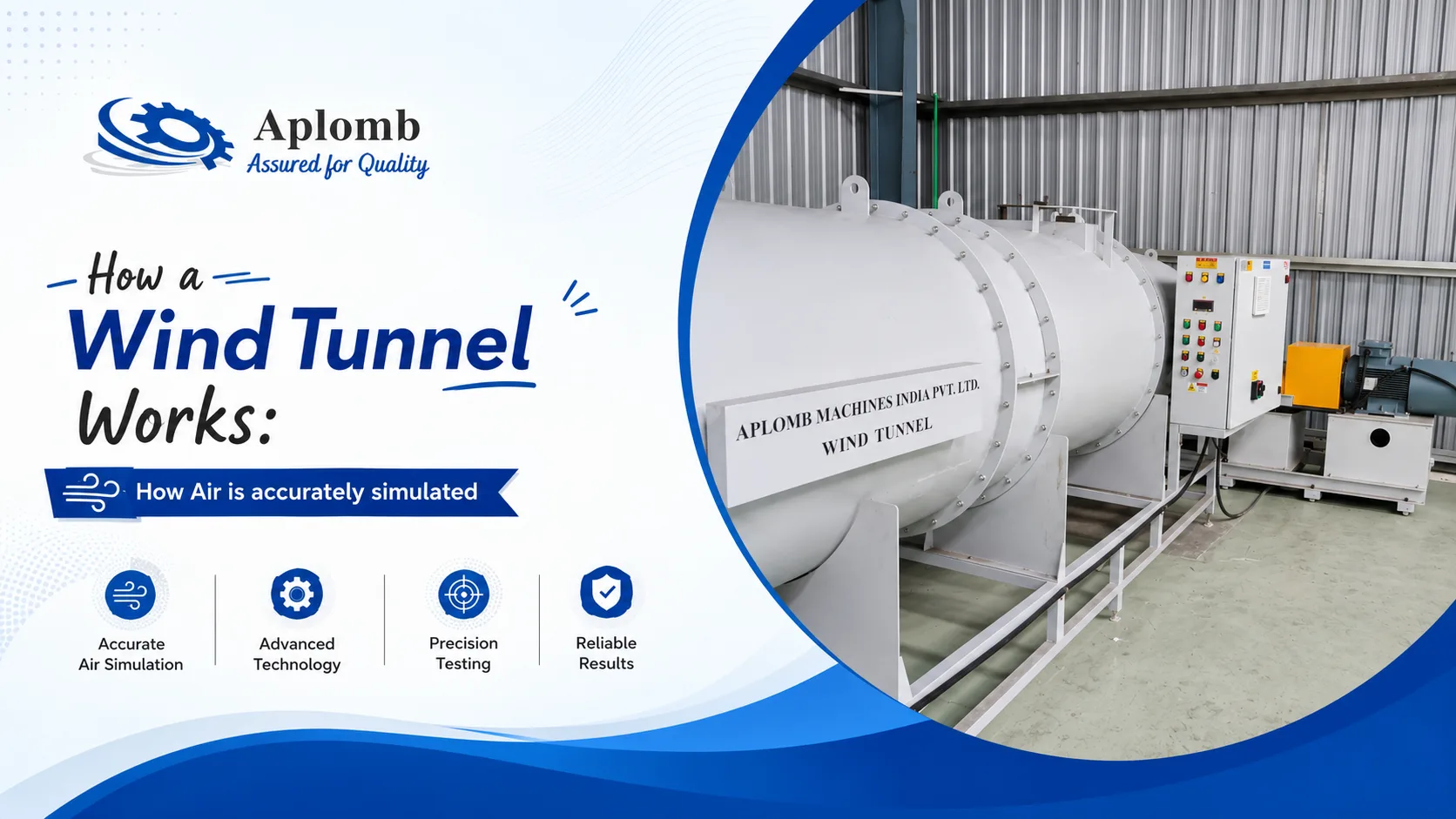
A wind tunnel is one of the most valuable testing systems used in engineering and product development. From aircraft and automobiles to buildings, drones, and industrial equipment, wind tunnels help engineers understand how air flows around an object before it is manufactured or used in real-world conditions. Aplomb Machines India Private Limited is a trusted manufacturer that continues to offer advanced wind tunnels designed for research institutions, educational organizations, automotive industries, aerospace applications, and industrial testing. Their precision-engineered systems deliver reliable results while supporting innovation and product development.
What Is a Wind Tunnel?
A wind tunnel is a specially designed testing chamber that simulates the movement of air over or around an object. Instead of moving the object through the air, the wind tunnel generates controlled airflow while the object remains stationary. Modern wind tunnels are equipped with advanced sensors, measuring instruments, and computerized data acquisition systems to provide highly accurate testing results. They are widely used to improve product performance, enhance safety, and reduce development costs.
How Does a Wind Tunnel Work?
Understanding how does a wind tunnel work helps explain why this technology is so important in engineering.
The working process involves several carefully controlled stages.
1. Air Intake
The process begins when powerful fans draw air into the wind tunnel. The airflow is generated at controlled speeds depending on the testing requirements.
Different applications may require low-speed, subsonic, or higher-speed airflow simulations.
2. Airflow Conditioning
Before entering the test section, the air passes through flow straighteners and honeycomb structures.
These components remove unwanted turbulence and create smooth, uniform airflow, ensuring highly accurate testing conditions.
3. Contraction Section
The airflow then moves through a contraction chamber where the air speed increases while maintaining a stable flow pattern.
This section ensures consistent velocity before the air reaches the testing area.
4. Test Section
The test section is the heart of the wind tunnel.
Here, the object being tested is securely mounted inside the chamber. As air flows around the model, engineers observe how the object reacts under different wind conditions.
How Do Wind Tunnels Work?
Instead of moving a vehicle or aircraft at high speed, wind tunnels move air around a stationary model. This controlled environment allows engineers to collect precise aerodynamic data without the cost and risk of full-scale field testing. By changing air speed, angle, pressure, and environmental conditions, engineers can evaluate different designs and optimize product performance before production begins.
This approach saves both time and development costs while significantly improving safety and efficiency.
Major Components of Wind Tunnels
A high-quality wind tunnel consists of several important components working together.
These include:
- Air intake system
- High-performance axial fans
- Flow straighteners
- Honeycomb structures
- Contraction chamber
- Test section
- Diffuser
- Air circulation system
- Control panel
- Data acquisition system
- Pressure sensors
- Velocity measuring instruments
Each component contributes to generating stable airflow and producing highly accurate testing results.
Benefits of Using Wind Tunnels
Organizations invest in wind tunnels because they provide several important advantages.
Accurate Aerodynamic Analysis
Controlled airflow allows engineers to study drag, lift, and pressure with exceptional precision.
Faster Product Development
Testing prototypes inside a wind tunnel helps identify design improvements early, reducing development time.
Cost Savings
Physical testing before mass production minimizes expensive design errors and product failures.
Improved Safety
Engineers can evaluate structural performance under different wind conditions without exposing people or equipment to unnecessary risks.
Better Product Performance
Optimized aerodynamic designs improve fuel efficiency, stability, durability, and overall performance.
Reliable Research Data
Educational institutions and research laboratories rely on wind tunnels to conduct repeatable and scientifically accurate experiments.
Industries That Use Wind Tunnels
Numerous industries benefit from aerodynamic testing.
These include:
- Aerospace
- Automotive
- Civil engineering
- Renewable energy
- Defense
- Marine engineering
- Railway transportation
Aplomb Machines India Private Limited continues to offer customized solutions for all these sectors.
By accurately simulating airflow under controlled conditions, wind tunnels enable engineers to improve product performance, increase safety, reduce development costs, and accelerate innovation. Whether used in aerospace, automotive, construction, renewable energy, or educational research, wind tunnels continue to shape the future of engineering. Aplomb Machines India Private Limited is proud to offer advanced wind tunnel solutions that deliver precision, reliability, and outstanding performance for organizations seeking world-class aerodynamic testing equipment.