
Modern manufacturing industries demand precision, speed, and energy efficiency for producing high-quality components. Traditional hydraulic and pneumatic presses have been widely used for decades, but advancements in automation have introduced a more efficient solution—the servo press.
Aplomb Machines India Private Limited is a trusted manufacturer of advanced industrial automation and pressing solutions. We offer high-performance press systems that combine precision engineering with innovative technology to improve productivity and reduce operating costs. Our solutions are designed to meet the requirements of automotive, electronics, aerospace, medical, electrical, and general manufacturing industries.
What is a Servo Press?
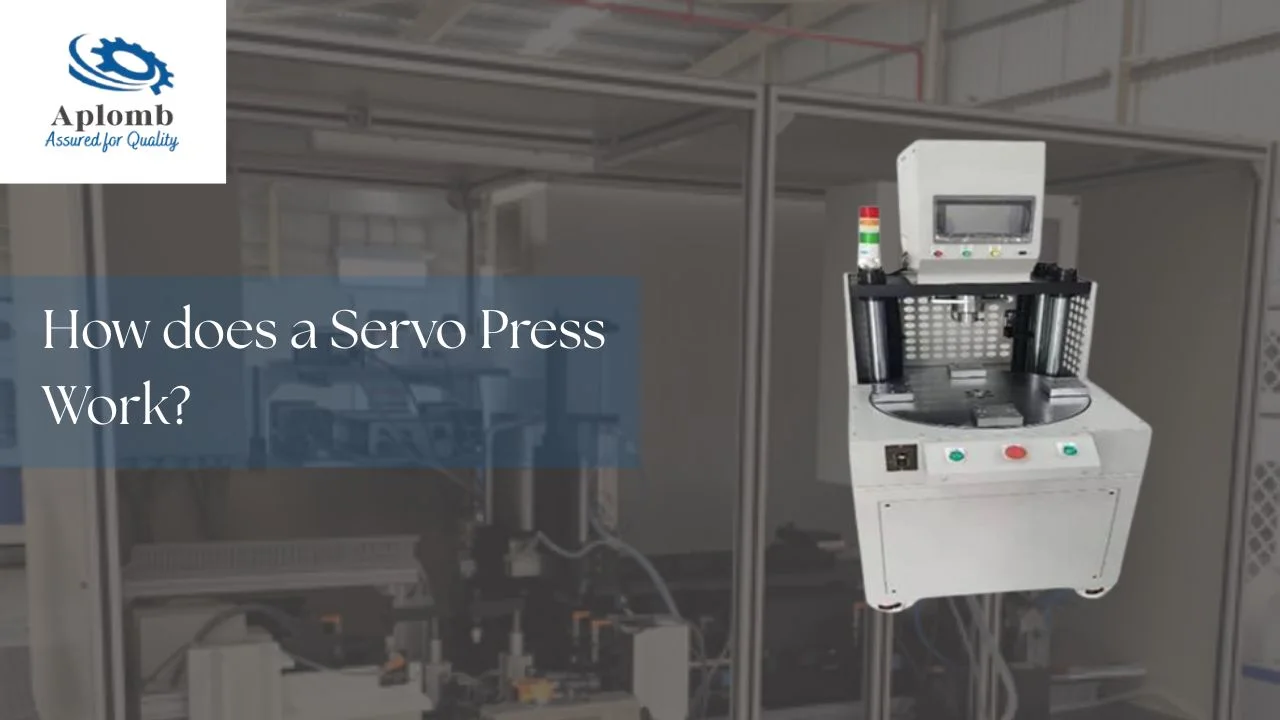
A servo press is a precision pressing machine that uses a servo motor instead of hydraulic or pneumatic power to generate force. The servo motor controls the movement of the ram with exceptional accuracy, allowing manufacturers to precisely adjust speed, stroke length, position, and pressing force according to the application.
An electric servo press offers programmable operation, real-time monitoring, and repeatable performance. This enables manufacturers to produce consistent results while minimizing material waste and reducing maintenance requirements.
How Does a Servo Press Work?
The working principle of a servo press machine is based on precise electronic motion control. Instead of using hydraulic oil or compressed air, the machine is powered by a high-performance servo motor that converts electrical energy into controlled mechanical movement.
The complete working process includes the following steps:
Step 1: Programming the Operation
The operator enters the required parameters into the control system, including stroke length, pressing force, speed, dwell time, and cycle sequence.
Step 2: Servo Motor Activation
Once the cycle starts, the servo motor begins rotating according to the programmed settings. Unlike conventional systems, the motor only operates when required, improving energy efficiency.
Step 3: Motion Transfer
The rotational movement of the servo motor is transmitted through a ball screw or mechanical drive system, converting rotational motion into linear movement.
Step 4: Ram Movement
The ram moves downward with controlled speed and force toward the workpiece. The machine maintains highly accurate positioning throughout the operation.
Step 5: Pressing Operation
The programmed force is applied to complete operations such as assembly, riveting, crimping, forming, bending, staking, or insertion. Sensors continuously monitor force and position to ensure precision.
Step 6: Return Stroke
After the pressing cycle is completed, the ram smoothly returns to its original position, preparing the machine for the next production cycle.
Step 7: Data Monitoring
Modern servo electric presses record important production data such as force, displacement, cycle time, and quality parameters, enabling manufacturers to maintain complete process control and traceability.
Features of Servo Press Technology
Modern industries prefer servo presses because they provide better performance compared to conventional mechanical systems. At Aplomb Machine Private Limited, we provide advanced solutions that help industries improve productivity and reduce operational costs.
- High Precision: A servo stamping press offers superior accuracy and repeatability. This makes it ideal for industries that require tight tolerances and detailed component manufacturing.
- Energy Efficiency: An electric servo press consumes power only during operation. This significantly reduces electricity consumption compared to traditional presses that run continuously.
- Flexible Motion Control: Manufacturers can program the speed, stroke length, and pressure according to specific applications. This flexibility increases production efficiency and minimizes waste.
- Reduced Noise and Vibration: A servo press operates more smoothly than traditional mechanical presses. Lower vibration and noise levels create a safer and more comfortable working environment.
- Improved Product Quality: The precise control provided by a servo press machine reduces defects, improves consistency, and enhances overall product quality.
Main Components of a Servo Press
A servo press consists of several precision-engineered components that work together for accurate operation.
Key components include:
- Servo motor
- Ball screw mechanism
- Press frame
- Ram
- Force sensor
- Linear encoder
- PLC control system
- HMI touch screen
- Safety system
- Electrical control panel
Each component contributes to smooth operation and consistent pressing performance.acy and speed are essential.
Why Choose Aplomb Machine Private Limited?
At Aplomb Machine Private Limited, we understand the importance of advanced manufacturing technology. We offer high-quality servo press machine solutions that are engineered for performance, durability, and efficiency. Our machines are designed using modern technology to deliver precise operations, energy savings, and reliable production output. Whether you need an electric servo press for high-speed production or a customized servo electric press for specialized applications.
A servo press is a modern industrial machine that combines precision, flexibility, and energy efficiency into a single system. By using advanced servo motor technology, manufacturers can achieve better production quality, reduced operational costs, and improved efficiency.
A servo press is one of the most advanced pressing technologies available for modern manufacturing. By using an electric servo press, industries achieve precise force control, programmable motion, energy efficiency, and consistent product quality. From automotive and electronics to aerospace and medical manufacturing, servo electric presses play a vital role in improving productivity and reducing operational costs. Aplomb Machines India Private Limited continues to offer reliable and high-performance servo press solutions that combine innovation, precision, and durability. Investing in advanced servo presses helps manufacturers enhance production efficiency, maintain superior quality standards, and stay competitive in today’s rapidly evolving industrial environment.