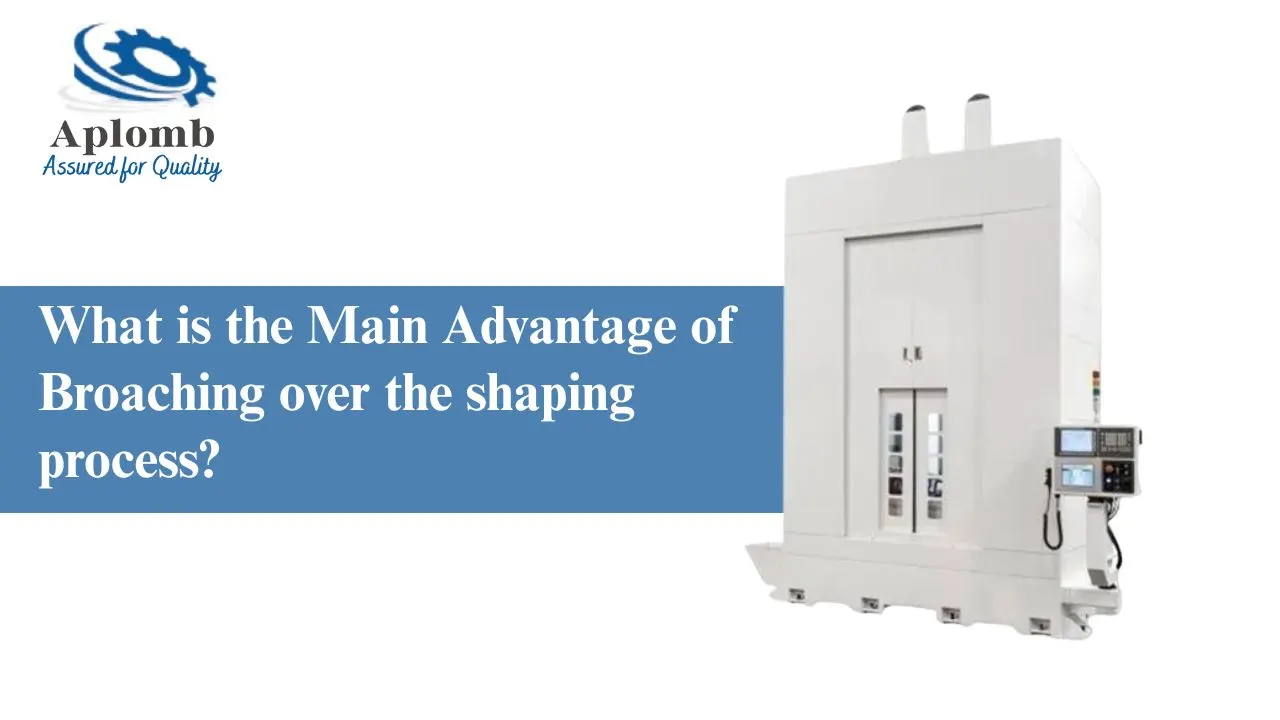
Aplomb Machines India Private Limited understands that when it comes to precision machining, manufacturers are constantly searching for methods that save time, improve accuracy, and reduce overall production costs. Two commonly compared machining techniques are broaching and shaping, and while both have their own applications, broaching clearly stands out in modern manufacturing environments. To truly understand why broaching is preferred, it is important to first look at the fundamentals and then explore the main advantage of broaching over the shaping process from a practical, real-world perspective. We provide advanced broaching solutions that help manufacturers achieve higher efficiency, consistent quality, and long-term operational value.
what is Broaching
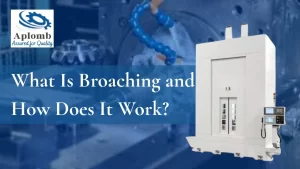
Broaching is a machining method in which a toothed cutting tool, known as a broach, is moved linearly across a workpiece to remove material. Each tooth on the broach removes a small amount of material, and the final teeth give the desired shape, size, and surface finish. The entire machining task is completed in a single pass.
The broaching process is widely used for producing internal and external profiles such as keyways, splines, gears, square holes, and other complex shapes. Due to its speed and precision, broaching is commonly applied in automotive, aerospace, heavy engineering, and mass production industries.
Understanding the Shaping Process
Shaping is a traditional machining process where a single-point cutting tool moves back and forth over a stationary workpiece to remove material. Unlike broaching, shaping removes material gradually, one stroke at a time. This makes shaping suitable for low-volume production or simple flat surfaces, but it becomes time-consuming for complex profiles.
While shaping has been used for decades, it struggles to match the productivity and precision demanded by modern industries.
Advantage of Broaching Over the Shaping Process
The main advantage of broaching over the shaping process is that broaching completes the machining operation in a single stroke, whereas shaping requires multiple passes. This single difference creates a ripple effect of benefits that make broaching far superior for high-precision and high-volume manufacturing.
1. Higher Productivity and Time Savings
In a broaching operation, multiple cutting teeth work simultaneously, each removing a small amount of material. This allows the entire profile to be machined in one continuous motion. In contrast, shaping requires repeated strokes, adjustments, and multiple tool passes.
2. Superior Accuracy and Consistency
Another major advantage of broaching is its exceptional dimensional accuracy. Since the broach tool is precisely designed, every part produced is nearly identical. Once the machine is set, the results remain consistent throughout the production run. This makes the broaching process especially suitable for industries where tight tolerances and repeatability are critical, such as automotive transmission parts and precision engineering components.
3. Excellent Surface Finish
Surface finish is a key quality factor in machining. Broaching produces a smooth and uniform surface because the finishing teeth of the broach refine the workpiece in the final stage of the cut. Shaping often requires additional finishing operations like grinding or polishing to achieve the same surface quality.
4. Capability to Produce Complex Shapes
One of the strongest advantages of broaching is its ability to produce complex internal and external profiles with ease. Shapes such as splines, keyways, and irregular contours are difficult and slow to produce using shaping. A single broaching operation can achieve these profiles accurately, making it a preferred choice for modern manufacturing units.
5. Reduced Labor and Skill Dependency
Shaping machines require skilled operators to manage tool alignment, stroke adjustments, and multiple passes. Broaching machines, once set up, require minimal operator intervention. This reduces dependency on highly skilled labor and minimizes human error. Manufacturers benefit from stable production and lower training costs.
6. Cost Efficiency in Large-Scale Production
Although the initial cost of broaching tools may be higher, the long-term benefits outweigh the investment. Faster cycle times, minimal rework, excellent surface finish, and reduced labor costs make broaching highly cost-effective for large-scale production.
Also Read : Hydraulic Shearing Machine and their Types
The main advantage of broaching over the shaping process lies in its ability to deliver speed, precision, and consistency in a single machining stroke. The broaching process outperforms shaping in productivity, surface finish, accuracy, and the ability to produce complex profiles. With advanced machine designs and industry expertise, Aplomb Machines India Private Limited continues to support manufacturers by delivering reliable broaching solutions. We provide machines that meet modern production demands, helping industries move toward higher efficiency and better quality outcomes.